

Today, on Remembrance Day, we take time to honour the courage, sacrifice, and service of those who have served our country — and those who continue to serve today.
At 11:00 a.m., we invite everyone to pause for a moment of silence in remembrance. Whether you are with a client, in an office, on the road, or taking a quiet moment between visits, please take this time to reflect in your own way.
Your kindness and dedication in caring for others each day reflect the same spirit of service we remember today. Thank you for all that you do for our clients and for our community.
On a more personal note, I wanted to share something close to my heart. A few years ago, I wrote a piece for our Community Connector Newsletter about my late grandmother, who played an important role during World War II. Like so many incredible women of her generation, she was a real-life “Rosie the Riveter,” helping to build Lancaster Bombers in Malton, Ontario. That’s actually why I have a painting of a Lancaster Bomber hanging in my office — it’s a daily reminder of her courage and the strength of so many women who stepped up during that time. I’ve recently updated her story, and if you’d like to read it, you can find it by scrolling further down. I hope it serves as a small reminder of the many personal stories behind this important day.
Lest we forget.
With appreciation,
Joel Duncan,
Director of Communications and Partnerships

Her Hands Built History: Part 1 - My Grandmother and the Women Behind Canada’s Lancaster Bombers
My grandmother, Dorothy Rose Taylor, lived a long and fulfilling life of 94 years, remaining remarkably independently utilizing services like CANES throughout her final years. She was sharp-minded, with an exceptional attention to detail that set her apart from others. That precision served her well from the very beginning — even in her first job as a riveter at Victory Aircraft Ltd. Assembly during the early days of the second World War.
My grandma grew up in the first half of the 20th Century which was both a great time of suffering and triumph. The Great Depression, World War II, and The Korean War are just some of the world events that have shaped her life. I often spoke to her about her experiences to find out what it was like to be a young woman in a time when the world was in turmoil. She explained that in wartime, everyone had to play a role. For women, that meant contributing to the war effort by taking a job at a military factory. So my grandma took her place among other young women on the assembly line in Malton, Ontario to build the famous Lancaster Bombers. I’ve always took interest in air shows and model airplanes, so you could imagine how excited I was hearing these stories from her as a child.
In the early years of the war, the British and their Allies made plans to build as many aircraft as possible. In order to do this, Britain needed to choose a manufacturing site that was well away from Nazi fire. Since the U.S. hadn’t entered the war yet, Canada became the obvious choice. At that time, Canada was still scarred by the Great Depression and its wartime asset was agriculture, not manufacturing. Becoming a manufacturing site was an immense challenge, but Canada was ready to take it on.
Initially, the manufacturing of the Lancaster Bombers was to go to the National Steel & Car Corporation of Malton, Ontario. They were already manufacturing Lysander aircraft and subcontracting the manufacture of Hurricanes and other fighter planes, but there were questions surrounding the company's ability to manage the Lancaster Bomber project. This led to the Government's expropriation of the plant in 1942 and the establishment of the Crown Corporation, Victory Aircraft Ltd. to produce the Lancasters.
The first blueprint to the first test flight took only sixteen months, which was an impressive accomplishment. Most of the workers were unskilled and about a quarter of them were women. Among them was my grandma. The first Canadian prototype of the Lancaster Bomber rolled off the Victory Aircraft assembly line on August 1, 1943.
My grandma used to take the train every day out to Malton from the Junction, at Dundas and Keele. Knowing how sharp my grandma was, it was no surprise to me that she was put in charge of Quality Control. This involved checking the rivets that held the plane together and ensuring that they were tight enough so that the plane wouldn’t fall apart. She was at the end of the assembly line where it was one of the last checks before the planes flew over the Atlantic. I’d say this was a pretty important job for a young 19 year old girl in those days.
The security was high at the factory. All the workers had security passes and wore uniforms and the ladies wore kerchiefs. There were only three women per shift who did the rivet repairs which required special training. My grandma was one of those three women. The rivets were brought out in a container and were very hot. Workers needed to wear big gloves to protect themselves from serious burns. The job was tough, but my grandma, like Canada, was the right choice for the job.
In the picture below, my grandma is standing on the wing with her co-workers in celebration of the 100th Lancaster off the line. I can’t imagine how proud she must have felt on that day. There is so much history and life experience that one can learn from their grandparents and I would encourage everyone to make an effort to unlock those stories. You’d be surprised at what you could learn about someone you thought you knew so well. I know I was. I’m proud of my grandma’s accomplishments and I know she was too. You could hear it in her voice. Yet my grandmother’s story with the Lancaster Bomber didn’t end there; seventy years later, she was reunited with one of the very aircraft she had helped to build. (continued below)

Return to the Airfield: Part 2 - Reliving a time when the world was at war
These massive bombers were known by many different names: “Fortresses in the Sky,” “The Dam Busters” or most commonly, “The Lanc”, and it played a huge part in the war. They bombed enemy airfields, destroyed dams and carried the largest payload of bombs of any WW2 bomber.
My grandma at the time started off as a riveter, ensuring that the panels on the plane were secure. She later moved up as a quality control expert supervising all the other riveters’ work.
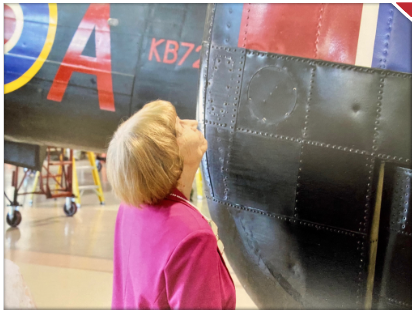
In 2019, family and friends gathered at the Canadian Warplane Heritage Museum in Hamilton, Ontario, to take a special tour with my grandma, who was 92 at the time. Walking among the massive, gleaming aircraft, she seemed transported back to the days of her youth. The museum is home to many vintage WWII planes, including one of the last two airworthy Lancaster Bombers in the world — the other resting across the ocean in Coningsby, UK. It was a moment of awe and reflection, seeing history up close with someone who had lived through it.
After touring about 30 other planes, we finally gathered beneath the towering Lancaster, with my grandma as the undisputed guest of honour. The museum staff were clearly impressed by her sharp memory, as she shared vivid stories of the struggles of maneuvering the heavy riveting gun across the bomber’s thick, armored panels. One young staff member, only 30 years old and currently part of the museum’s restoration team, was especially captivated—he himself works as the Lancaster’s current riveter. Excited to meet one of the last surviving WWII riveters, he handed her the modern riveting gun he uses today. With a twinkle in her eye, my grandma lifted it and said, “It’s not that heavy.” It truly was hefty—but nothing compared to the guns of the 1940s. In that moment, decades of history, skill, and determination seemed to bridge the generations, and we all felt the quiet awe of standing alongside someone who had shaped history with her own hands.

The young man then led her on a private tour around the massive plane. As I watched, the sheer size of the Lancaster made my grandma seem tiny beneath its wings and fuselage.
I could easily imagine her crawling along those enormous surfaces, a 15-pound riveting gun in hand, working with precision and determination. My grandma was a real-life Rosie the Riveter, shouldering the tremendous responsibility of making sure every single rivet was secure on planes like this— machines that would one day carry out critical missions, striking heavy dams and delivering blows to the enemy.

Many young men fought and died as heroes on the front lines, but countless others worked tirelessly behind the scenes, redefining what it truly meant to be heroic. I believe my grandma was one of those heroes, especially evident to those who saw her gazing up at that Lancaster that day.
Revisiting the plane after so many years must have brought back a flood of memories for her. I am certain that those experiences—both the triumphs and the challenges—helped shape the remarkable woman she became, the loving and inspiring grandmother we were so fortunate to have.

On this November 11th, we remember not only those who fought on the front lines but also the countless men and women who gave everything they could behind the scenes. I am deeply grateful to the Canadian Warplane Heritage Museum for guiding my grandma and our family through the hangar that day and for preserving such an extraordinary piece of history. Each time that Lancaster Bomber thunders across the sky—as it still does—I am filled with awe and gratitude, thinking of heroes past and present. And among them, one stands out in my heart: my grandma, Dorothy Rose Taylor, whose courage, skill, and quiet strength helped shape history in ways big and small.